

We Built Better Businesses. Now We Need Better Ways to Transfer Them.
The social enterprise movement has spent decades building businesses that create value for workers, communities, and the planet. Now we need better buyers, ownership models, capital, and marketplaces to help those businesses transfer without losing what made them different.
We Built Better Businesses. Now We Need Better Ways to Transfer Them.
For more than twenty years, the social enterprise movement has worked to prove that business can create value without extracting it from workers, communities, and the planet. We built B Corps, benefit corporations, cooperatives, employee-owned companies, steward-owned businesses, and thousands of enterprises that measure success by more than profit alone.
Then an owner decides to sell, and much of that progress is handed back to a transaction system that was not built to recognize it.
The sale process still sees only part of the business
Most business-sale infrastructure does a reasonable job of organizing companies by industry, location, revenue, profit, and asking price. Those numbers matter, but they do not tell a buyer why the company matters or what could be lost in the transition.
A social enterprise may have spent years developing fair employment practices, trusted supplier relationships, environmental commitments, community partnerships, and a culture that attracts people who could work almost anywhere. None of that fits neatly into an EBITDA multiple, yet it can disappear quickly under the wrong ownership.
The conventional market does not necessarily oppose those values. It simply was not designed to ask about them. When a marketplace or deal process cannot capture what an owner hopes to protect, those priorities become side conversations rather than part of how buyers are found and evaluated.
That leaves many founders believing they face two choices: sell to whoever will pay the most or close the business rather than watch the wrong buyer dismantle it. That is not a functioning market for social enterprise. It is a failure of imagination and infrastructure.
Purpose becomes most vulnerable when control changes
A founder can protect purpose through daily decisions for decades. A change in ownership can reset those decisions in a matter of months.
Certification helps. Legal benefit status helps. Strong governance and transaction terms help. But none of them replaces the need to find a buyer whose incentives, time horizon, and plans are compatible with the company’s future.
A buyer planning to integrate the business, eliminate overlapping roles, and resell within a few years is offering something materially different from a buyer that intends to retain the team and hold the company indefinitely. The purchase price may be similar. The outcome will not be.
Whole Foods offers a useful example. It began as a community-rooted natural foods business and became one of the country’s most recognizable values-led companies. But as it scaled, went public, faced activist pressure, and ultimately sold to Amazon, the forces shaping the company changed.
Our narrative episode traces what happened to the business, its workers, local vendors, and broader mission once it became part of a global logistics system.
From Kale to Data Node: What Happened When Amazon Bought Whole Foods
Better transitions require more than a new marketplace
The missing infrastructure is broader than a place to post listings. Owners need earlier access to employee ownership, steward ownership, cooperatives, long-term buyers, mission-aligned capital, and advisors who understand that a successful exit may include more than maximizing the check at closing.
They also need a way to communicate those priorities before a buyer has already been selected. Employee continuity, community presence, ownership structure, intended hold period, mission protection, and plans for the company should help shape the buyer pool from the beginning.
Some owners may discover that the right next owners already work inside the company. Others may find an individual operator, an employee-owned acquirer, a family office, or a long-hold buyer capable of carrying the business forward. A stronger market does not push every owner toward the same model. It makes more of those models visible while there is still time to act.
Building the next layer of the social enterprise economy
Steward Market was created as one piece of this missing infrastructure. It gives owners a place to describe not only what they are selling, but what they want the next owner to protect. Buyers can share their ownership model, time horizon, operating approach, values, and plans after closing, while advisors and capital providers can make alternative transition paths easier to find.
The platform does not replace brokers, attorneys, accountants, lenders, or transaction advisors. It gives those professionals and the owners they support a wider set of buyers, models, and questions to work with.
This full seller demonstration shows how an owner can create a confidential profile, explore potential buyers, and stay in control of what is shared and when.
Watch the Steward Market Seller Demo
The social enterprise movement has already shown that companies can govern differently, employ differently, source differently, and share value differently. Ownership transition should not be the moment when all of that work becomes invisible.
We built better businesses. Now we need the buyers, capital, advisors, ownership models, and marketplaces that allow those businesses to transfer differently too.
In solidarity,
Hannah
Other Articles You May Like
September 14, 2026
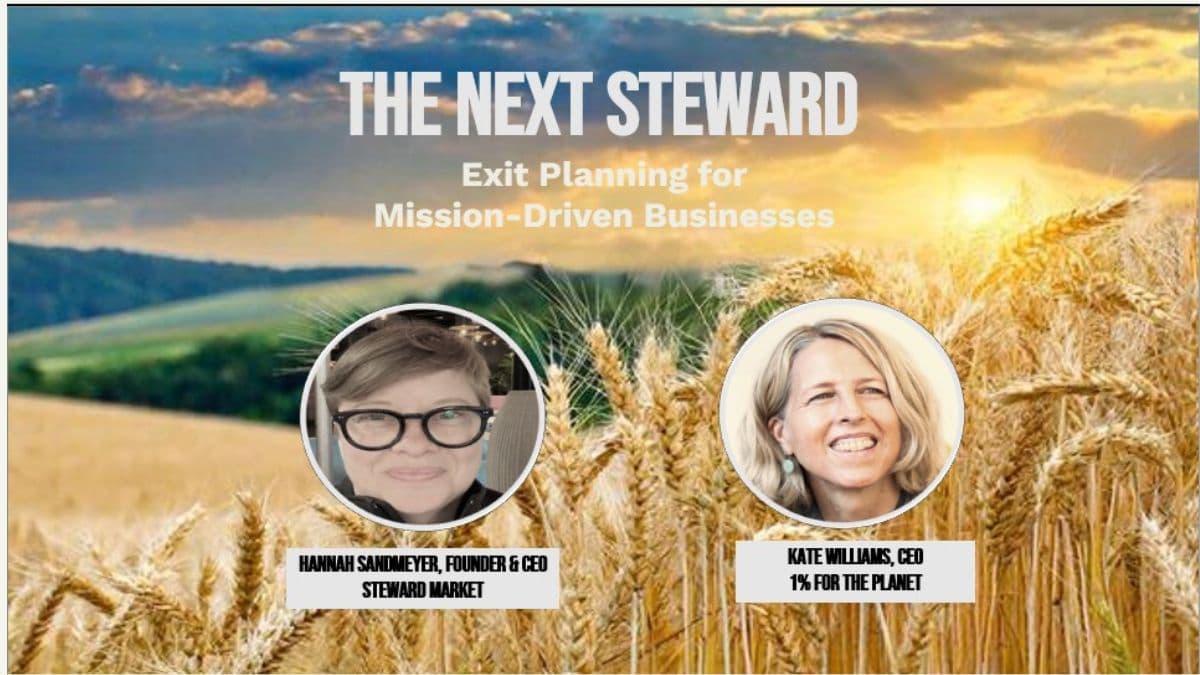
Webinar Recording: The Next Steward
Watch Hannah Sandmeyer of Steward Market and Kate Williams of 1% for the Planet discuss why exit planning is impact planning for mission-driven founders, and how to protect what matters through succession, sale, capital transition, or ownership change.
July 13, 2026
B Lab U.S. & Canada Officially Supports Steward Market's Mission
B Lab, the nonprofit behind B Corp Certification, has officially voiced support for Steward Market. This post explains what B Lab is, what the support means for Sellers, Buyers, intermediaries, and capital partners, and how it connects to Steward Market's commitment to transparency, seller dignity, and stewardship as a discipline, not a sentiment.

May 1, 2026
What Alignment Actually Looks Like in a Good Deal
Alignment is one of dealmaking's most overused and least defined words. It's not a feeling — it's a structural outcome that protects what matters under stress.

August 3, 2026
How to Find a Buyer Who Will Protect What You Built
Selling your business does not have to mean losing the employees, culture, mission, or community impact you worked to build. Here is how to define what matters, evaluate different buyer types, explore employee ownership, and find a buyer capable of becoming the company’s next steward.