

How to Find a Buyer Who Will Protect What You Built
Selling your business does not have to mean losing the employees, culture, mission, or community impact you worked to build. Here is how to define what matters, evaluate different buyer types, explore employee ownership, and find a buyer capable of becoming the company’s next steward.
How to Find a Buyer Who Will Protect What You Built
For many business owners, the hardest part of selling is not the price. It is the fear of what happens next.
Will the buyer keep the team, protect the culture, stay in the community, and honor the mission? Or will the company be folded into something larger, stripped down, or sold again in a few years?
Those are not soft concerns. They are part of the value of the business. The mistake is waiting until the end of a sale process to raise them, when the likely buyer has already been selected and the economics are driving the conversation.
The better approach is to decide what you want to protect before you start looking for a buyer.
Start with your definition of a successful exit
A successful exit may include a strong financial return. It may also include keeping employees in place, preserving the company name, maintaining benefits, protecting supplier relationships, staying rooted in the community, or continuing a social or environmental mission.
Write those priorities down and treat them as actual decision criteria, not vague hopes. You may not get everything you want, but if you have not defined what matters, your advisors and potential buyers will default to the easiest thing to measure: price.
The highest offer may still be the right offer. It just should not win automatically.
Understand what different buyers are built to do
Buyer structure matters because incentives matter.
A strategic buyer may be willing to pay more because it expects to combine teams, eliminate duplicate costs, or absorb your company into a larger operation. A private equity buyer may bring capital and expertise, but often operates within a defined investment period and expects another sale. An individual operator, family office, permanent-capital buyer, employee-owned company, cooperative, or steward-owned acquirer may have a much longer horizon.
None of those labels guarantees a good outcome. Buyer type is only the beginning of the diligence.
What matters is what the buyer plans to do, how the acquisition is being financed, how long they expect to own the business, and what happened after their previous deals. Ask directly about employee retention, brand continuity, location, leadership, benefits, and resale plans. Then ask for references and call them.
A buyer’s history is more useful than a polished presentation about legacy.
Consider employee ownership early
For some owners, the right next stewards may already work inside the company. Employee ownership can create continuity, protect jobs, and allow the people who helped build the business to participate in its future value. Depending on the company, that could mean an ESOP, an employee ownership trust, a cooperative, or another employee-led structure.
It will not work for every business. Size, profitability, financing, leadership readiness, and the owner’s liquidity needs all matter. But it should be explored while there is still time to shape the transition, not after every other path has already been set in motion.
For a practical overview of the major employee ownership models, this episode of Ethical Exits is a great place to start. Project Equity’s Stacey Smith breaks down ESOPs, cooperatives, and employee ownership trusts, explains what makes a business “EO ready,” and explores how employee ownership can support succession, resilience, wealth creation, and even growth through acquisition.
Why Employee Ownership Is the Best Kept Secret in Business
Employee ownership can also shape the buyer, not just the seller’s exit. Empowered Ventures acquires businesses into a diversified employee-owned holding company designed for long-term ownership, job continuity, and shared wealth creation. In this episode, CEO Chris Fredericks explains what that model looks like in practice and why the market needs more buyers built to hold rather than flip.
The Next Evolution of Employee Ownership
Diligence alignment, then protect it
Finding a buyer who says the right things is not enough. The transaction itself needs to support the outcome.
That may include employee retention incentives, leadership agreements, commitments around benefits, protections for the brand or location, governance rights, purpose covenants, or limits on certain future decisions. Not every promise can be made permanent, and most sellers will give up control after closing. That is the reality of transferring ownership.
Still, there is a wide gap between total control and blind trust. An experienced M&A attorney can help determine which protections belong in the purchase agreement, governance documents, financing structure, or ownership design.
M&A attorney Jim Black joined Ethical Exits to discuss how founders can approach legal structure and transaction terms when mission protection matters:
From Big Law to Big Impact: Building Exits That Protect Your Mission
Look for buyers in places built around more than price
Most business marketplaces organize opportunities around industry, revenue, geography, and asking price. That creates reach, but it does not create alignment.
The owner is still left to determine whether a buyer intends to protect employees, maintain the mission, hold the business for the long term, or sell it again as quickly as possible.
Steward Market was built to make those questions part of the process earlier. Owners can create a confidential seller profile, share what they want the next owner to protect, explore different buyer types, and decide when identifying information is disclosed.
Buyers can communicate their ownership model, hold period, values, operating approach, employee commitments, and plans after closing. The platform also includes advisors and capital providers who support employee ownership, steward ownership, mission-aligned acquisitions, and other forms of responsible transition.
There are no commissions or success fees. The goal is to give owners another way to look for the right buyer without forcing the entire process to begin and end with price.
This full walkthrough shows how an owner can use Steward Market to explore potential buyers, communicate what matters, and stay in control of the process:
Watch the Steward Market Seller Demo
You have more agency than you think
You may not be able to control everything that happens after a sale, but you can control how early you begin, which buyers you consider, what you ask, and which terms you are willing to accept.
Get clear about what matters before the process starts. Look beyond the obvious buyer pool. Diligence the buyer as seriously as they diligence you. Then work with the right advisors to put meaningful protections into the structure of the deal.
The goal is not simply to find someone willing to buy the business. It is to find someone capable of becoming its next steward.
In solidarity,
Hannah
Other Articles You May Like
September 14, 2026
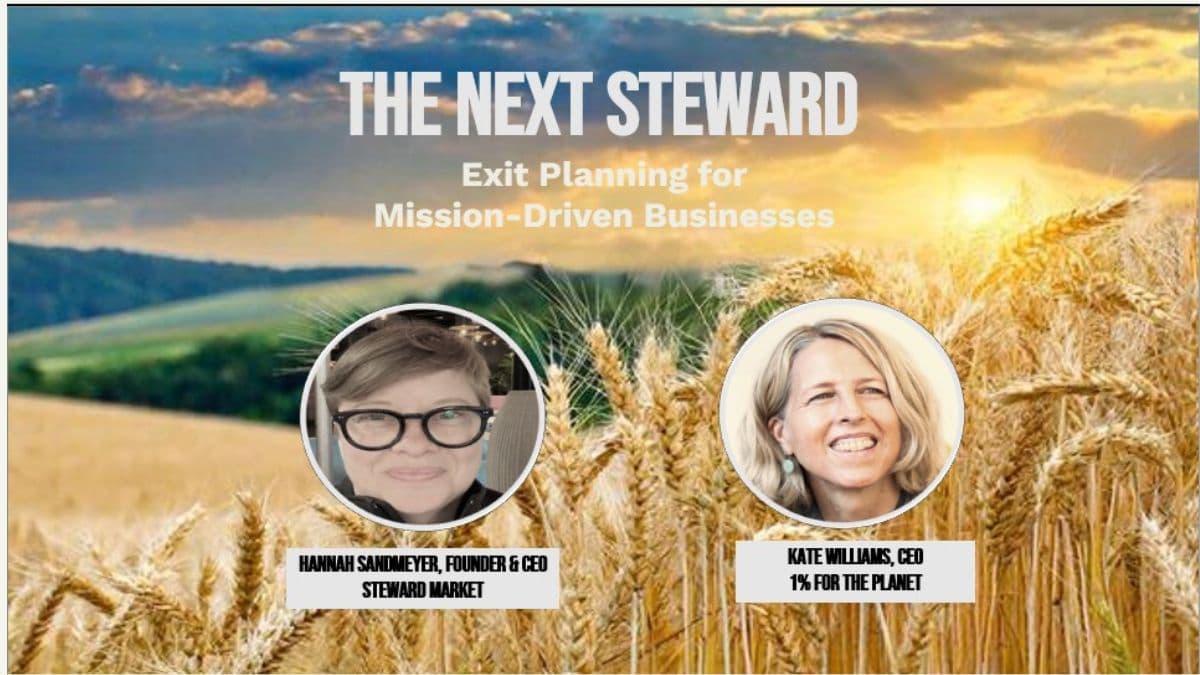
Webinar Recording: The Next Steward
Watch Hannah Sandmeyer of Steward Market and Kate Williams of 1% for the Planet discuss why exit planning is impact planning for mission-driven founders, and how to protect what matters through succession, sale, capital transition, or ownership change.

May 1, 2026
Valuing Your Values: How Purpose Shows Up in Deal Structure and Deal Price
Values aren't a tax on a transaction — they shape who shows up, how risk is priced, and what survives the close. The only question is whether they're explicit or default.

May 1, 2026
Employee Ownership Models 101
Employee ownership isn't one structure but a set of approaches — ESOPs, co-ops, EOTs, steward-ownership, perpetual trusts — each making different tradeoffs between economic share and decision-making power.

May 1, 2026
Ethical Exits Are Not Neutral
Exits aren't neutral technical events — they're purposeful inflection points whose design choices shape the fate of employees, communities, and the broader economy long after closing.

August 19, 2026
We Built Better Businesses. Now We Need Better Ways to Transfer Them.
The social enterprise movement has spent decades building businesses that create value for workers, communities, and the planet. Now we need better buyers, ownership models, capital, and marketplaces to help those businesses transfer without losing what made them different.