
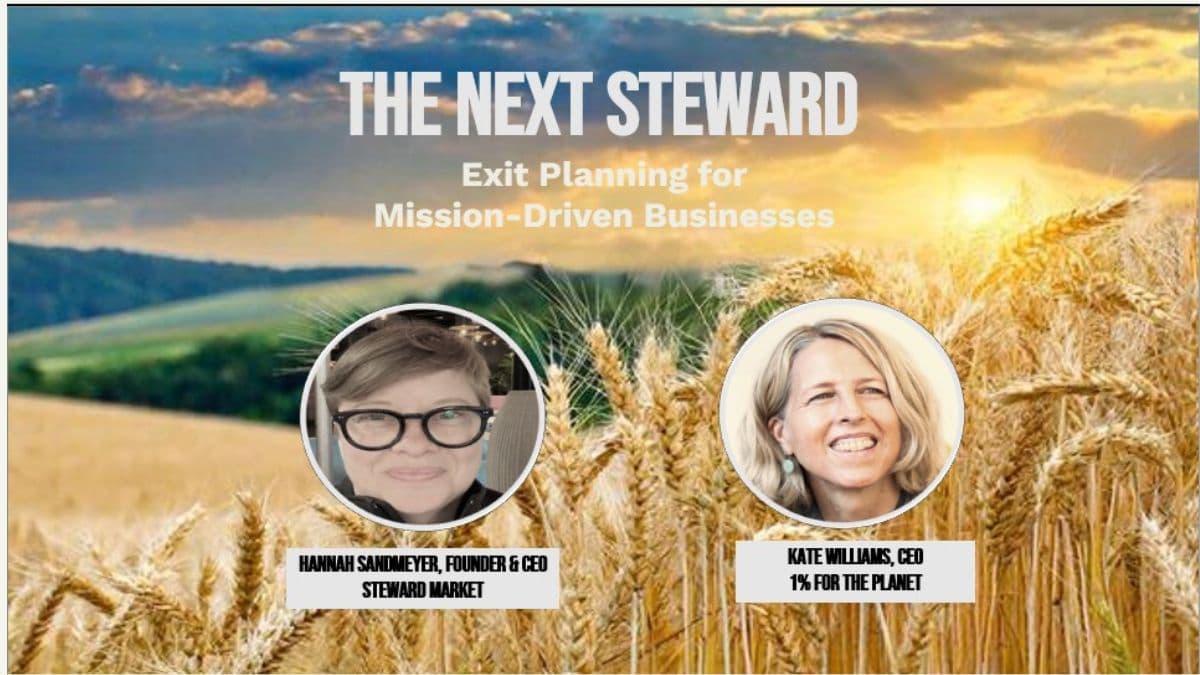
Webinar Recording: The Next Steward
Watch Hannah Sandmeyer of Steward Market and Kate Williams of 1% for the Planet discuss why exit planning is impact planning for mission-driven founders, and how to protect what matters through succession, sale, capital transition, or ownership change.
The Next Steward: Exit Planning for Mission-Driven Businesses
A conversation with Kate Williams, CEO of 1% for the Planet
What happens to a company’s mission when ownership changes?
That was the question at the center of The Next Steward: Exit Planning for Mission-Driven Businesses, a conversation between Hannah Sandmeyer, Founder & CEO of Steward Market, and Kate Williams, CEO of 1% for the Planet.
For many founders, succession planning can feel heavy. It can feel like homework. Or like the beginning of the end.
But for mission-driven businesses, exit planning is not only a financial exercise. It is a stewardship decision. It is a chance to ask what has been built that is worth carrying forward, who might be the right next steward, and what becomes possible if the next chapter is designed with care.
Watch the recording here
Why this conversation matters now
1% for the Planet is approaching its 25th anniversary and nearly one billion dollars in certified environmental giving. That is an extraordinary impact milestone. It is also a stewardship milestone.
Many founder-led businesses begin facing real questions about succession, leadership transition, ownership change, or long-term stewardship around the same 25- to 30-year stage. The question is no longer only how mission-driven businesses are built or scaled. It is how their commitments become durable enough to survive leadership and ownership change.
That matters because ownership transition is one of the highest-risk moments in the life of a mission-driven company.
Employees, culture, environmental commitments, supplier relationships, community presence, and mission can all become vulnerable when control changes hands.
And yet, this moment can also be one of the greatest levers of impact.
From fear to impact planning
Many founders carry a quiet fear that when the time comes, no one aligned will come. Or that the only path available will require them to compromise the very things that made the business worth building.
But that is not the only story.
Mission-preserving transition models are developing. Aligned buyers, employee ownership pathways, steward ownership structures, patient capital, community ownership models, and values-aligned advisors are becoming more visible.
The work begins with a different question: What do you want protected when you are no longer the person making the decisions?
For some founders, the answer is employees. For others, it is environmental commitments, local jobs, community relationships, supplier standards, culture, or the mission itself. Naming those priorities is step one. Protecting them in a transaction takes preparation and strategy.
What 1% for the Planet has learned about durable commitment
Kate grounded the conversation in the 1% for the Planet model: businesses commit to giving 1% of top-line revenue to environmental and impact partners every year, and 1% certifies that the commitment has been fulfilled.
That annual accountability matters. It turns values into an operating practice.
Kate described 1% for the Planet’s work as helping companies build “a steady, consistent way of allocating resources to the things that they value.” The commitment is not meant to be a one-time campaign or a charitable add-on. At its best, it becomes part of how a company operates, makes decisions, and defines success.
As companies grow, mature, raise capital, or change ownership, that durability becomes even more important.
Kate shared that she has had direct conversations with companies thinking creatively about succession, including ideas like giving a nonprofit partner a board seat or otherwise embedding impact commitments more deeply into governance. She also noted that some companies have been clear with investors from the outset that their 1% commitment is not negotiable.
What role should networks play?
Another important question was whether organizations like 1% for the Planet, B Lab, Purpose Pledge, People and Planet First, and other values-based networks should play a role in helping members prepare for ownership transition.
Kate described 1% for the Planet as an ecosystem built on the foundation of annual certification. Within that ecosystem, more can happen: education, conversation, resource sharing, and connecting members to people who can support them in areas where 1% is not the technical expert.
That is one of the opportunities ahead for the broader mission-driven business community.
If networks help companies build credible commitments during their operating life, they may also have an important role to play in helping those commitments survive succession, sale, capital transition, or ownership change.
The question founders should start asking now
Toward the end of the conversation, Kate offered a simple and powerful question for founders:
What will you feel most proud of when you get to the other side of the transition?
From there, founders can backward-plan.
If what they want to protect is care for employees, they can explore employee ownership or governance structures that make those commitments more durable. If they want environmental commitments to continue, they can think about how to embed those commitments into the company’s strategy, governance, capital structure, or future ownership.
That question changes the starting point.
Instead of beginning only with price, speed, or close probability, founders can begin with the outcome they want to make possible.
Exit planning is impact planning
The traditional M&A market is largely optimized around price, speed, and closing probability.
Those things matter. But for mission-driven companies, they are incomplete.
If values are part of enterprise value, then stewardship fit also has to be part of the planning process. If culture, employees, brand trust, environmental commitments, and community relationships are part of what makes a business worth preserving, they should not be treated as secondary to the transaction.
Founders often have more options than they realize, including mission-aligned buyers, employee ownership, steward ownership, perpetual purpose trusts, community ownership, internal succession, patient capital, or partial transitions that create more time and optionality.
The earlier founders begin exploring, the more options they can preserve.
How Steward Market helps
Steward Market exists to make better ownership pathways easier to discover before founders are alone in a transaction process.
The marketplace brings together sellers, buyers, advisors, banks, capital providers, and ecosystem partners in one place, with values, ownership intent, stewardship pathways, certifications, and transition priorities made more visible and searchable.
Sellers can create masked listings that protect their identity while signaling what they built and what they want protected. Buyers can describe not only what they want to acquire, but how they intend to own. Partners can help founders find the capital, legal structure, advisory support, and ecosystem guidance they need earlier in the process.
Better signals create better conversations earlier.
Start before the transaction starts
You do not need to know exactly when, how, or to whom you will transition your business.
But you do need to know what you want protected.
Start by naming what matters. Then map the pathways. Build the right bench. And when the time is right, make your intent visible.
The best exits do not simply return capital. They transfer stewardship.
Other Articles You May Like

August 3, 2026
How to Find a Buyer Who Will Protect What You Built
Selling your business does not have to mean losing the employees, culture, mission, or community impact you worked to build. Here is how to define what matters, evaluate different buyer types, explore employee ownership, and find a buyer capable of becoming the company’s next steward.
August 19, 2026
We Built Better Businesses. Now We Need Better Ways to Transfer Them.
The social enterprise movement has spent decades building businesses that create value for workers, communities, and the planet. Now we need better buyers, ownership models, capital, and marketplaces to help those businesses transfer without losing what made them different.
July 13, 2026
B Lab U.S. & Canada Officially Supports Steward Market's Mission
B Lab, the nonprofit behind B Corp Certification, has officially voiced support for Steward Market. This post explains what B Lab is, what the support means for Sellers, Buyers, intermediaries, and capital partners, and how it connects to Steward Market's commitment to transparency, seller dignity, and stewardship as a discipline, not a sentiment.